The future of housing is no longer a concept relegated to architectural schematics or science fiction—it is a tangible reality taking shape right now in Hudson, New Hampshire. Nestled in a peaceful landscape, Barrett Hill is a bold residential development setting a new benchmark for environmentally conscious living in New England—and a model for communities across the country.
Barrett Hill is built by Aspire Residential, and their project goes beyond simply constructing homes; it reimagines how communities can thrive through energy independence, health-conscious design, and a deep commitment to the planet. With a focus on advanced high performance building and renewable energy systems, Barrett Hill shows that modern comfort can truly coexist living responsibly.
The thirteen-lot, twenty-six-unit “condex” subdivision is fully electric and designed to achieve net-zero energy—meaning each home produces as much energy as it consumes annually. The foundation of the project’s performance begins well before construction, with each home built to the rigorous Passive House Standard and certified under the United States Department of Energy (DOE) Net Zero Energy Ready Home Program. This results in an exceptionally airtight and highly efficient building envelope that dramatically reduces energy demand from day one—long before solar panels or other renewable systems are installed.
A hallmark of Barrett Hill is its focus on energy independence and resilience. Each home is equipped with a rooftop solar array, carefully sized to meet its annual energy requirements. In addition, homeowners have the option to install a battery backup system, ensuring reliable power during outages and acting as a quiet, emission-free generator. This on-site energy generation is approximately three times more efficient than drawing electricity from the conventional grid, making it both environmentally and economically beneficial.
According to John Gargasz, founder of Aspire Residential, the design and construction process required to reach net-zero energy standards is detailed and complex—but the payoff for future homeowners is well worth the effort. “Imagine taking your $565 monthly energy bill to zero (combined electricity, heating fuel, and wood).” This has a dramatic impact on your mortgage payment,”
Barrett Hill also delivers tangible lifestyle benefits that go beyond energy savings. Thanks to advanced insulation and high-performance windows, the homes are approximately fifty percent quieter than traditional construction. This provides an enhanced daily living experience that brings peace and comfort to every room.
Indoor air quality is another top priority. Each home complies with the Environmental Protection Agency (EPA) Indoor airPLUS program, ensuring that air is continuously circulated and filtered. The ventilation systems are designed to remove indoor pollutants and bring in a steady supply of fresh air. To further support healthy living, the flooring, cabinetry, carpeting, and paint were all selected based on strict air quality and emissions standards.
In line with its future-forward vision, every Barrett Hill home is also electric vehicle (EV) ready. A pre-installed garage circuit enables convenient home charging and allows for the potential installation of a bidirectional charger. This capability can power the home during grid outages and further enhance the home’s resilience, especially in emergencies or severe weather events.
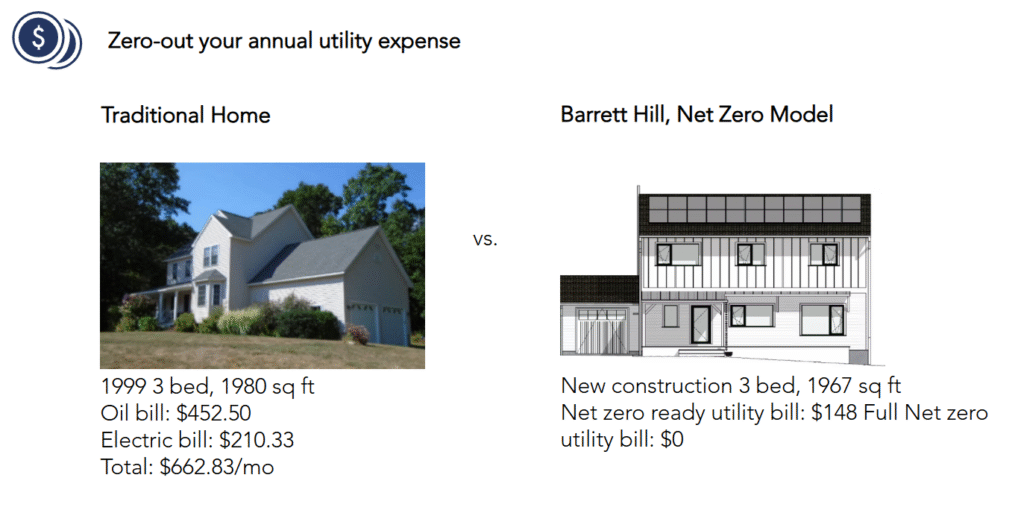
From both financial and environmental perspectives, the benefits of these homes are substantial. Homeowners at Barrett Hill can enjoy annual utility bills of zero dollars—an impressive contrast to older homes built in the 1990s, which may cost more than six hundred dollars per month in combined oil and electricity expenses. These savings contribute to long-term financial stability, allowing residents to invest in other priorities while reducing their dependence on fossil fuels.
Homeowners also benefit from financial incentives. Federal tax deductions apply to solar installations, and residents can choose to sell Renewable Energy Credits (RECs) for additional income. These advantages lower upfront costs and provide ongoing economic value that makes net-zero living not only attainable but advantageous.
Environmentally, the project’s impact is equally meaningful. The Barrett Hill construction team succeeded in reducing carbon dioxide (CO2) emissions from building and operational activities by nearly forty percent. This achievement significantly lowers the development’s overall carbon footprint. Over a ten-year period, each home is estimated to prevent around eighty tons of CO2 emissions, which is equivalent to removing several conventional vehicles from the road for the same duration. These reductions represent an important contribution to the fight against climate change.
The success of Barrett Hill is also the result of thoughtful partnerships. Eversource, through its New Hampshire Clean Energy Fund Battery Demand Response program, provides upfront incentives to support the installation of home battery systems. Sustainable Energy Analytics, an Eversource-approved Home Energy Rating System (HERS) rater, conducted comprehensive assessments throughout the construction process. These evaluations ensured that each home met energy performance targets and qualified for available incentives.
Ultimately, Barrett Hill is far more than a housing development—it is a working blueprint for the future of homebuilding. Aspire Residential has created a community that harmonizes cutting-edge design, economic accessibility, and environmental stewardship. It serves as proof that sustainable living can be both practical and appealing, offering lasting benefits for individuals, families, and the broader environment. barretthillhudson.com.
The development also includes seventeen acres of permanently conserved land, offering residents access to natural spaces for walking, hiking, and reconnecting with nature. This feature reinforces the project’s message that living well and living responsibly can—and should—go hand in hand.
As Sam Evans-Brown, Executive Director of Clean Energy New Hampshire, noted, “The economies of scale and the opportunity to train subcontractors in high performance building is a plus and the homeowners benefit with $4-5K in energy savings .” Barrett Hill is not just energy out building houses—it is about creating a better world, one home at a time.
This article was written for the Green Energy Times by Guy Payne, the executive director of the Sustainable Energy Outreach Network (SEON).